Production AI Support Agent (Guardrail-First)
Risk-aware LLM-powered support agent reducing customer support load
Overview
An autonomous LLM-powered support agent designed to safely reduce customer support load without increasing operational or financial risk. The system autonomously replies to customer emails when safe, enriches internal context for human operators when unsafe, and prioritizes guardrails over coverage.
Problem
Customer support teams frequently receive repetitive questions related to product usage and payment charges. These inquiries are high volume but also high risk, particularly when financial data is involved. The challenge was not response quality, but knowing when not to respond.
The goal was to reduce support load by introducing an autonomous agent that:
- Responds independently when confidence is high
- Escalates deterministically when confidence is low
- Never performs admin actions
- Never writes or mutates payment data
This was a risk-reduction problem, not an automation-for-automation problem.
Solution
The agent was designed to answer only well-scoped product and payment questions, escalate deterministically on admin requests or uncertainty, and operate under strict read-only constraints for sensitive systems such as Stripe.
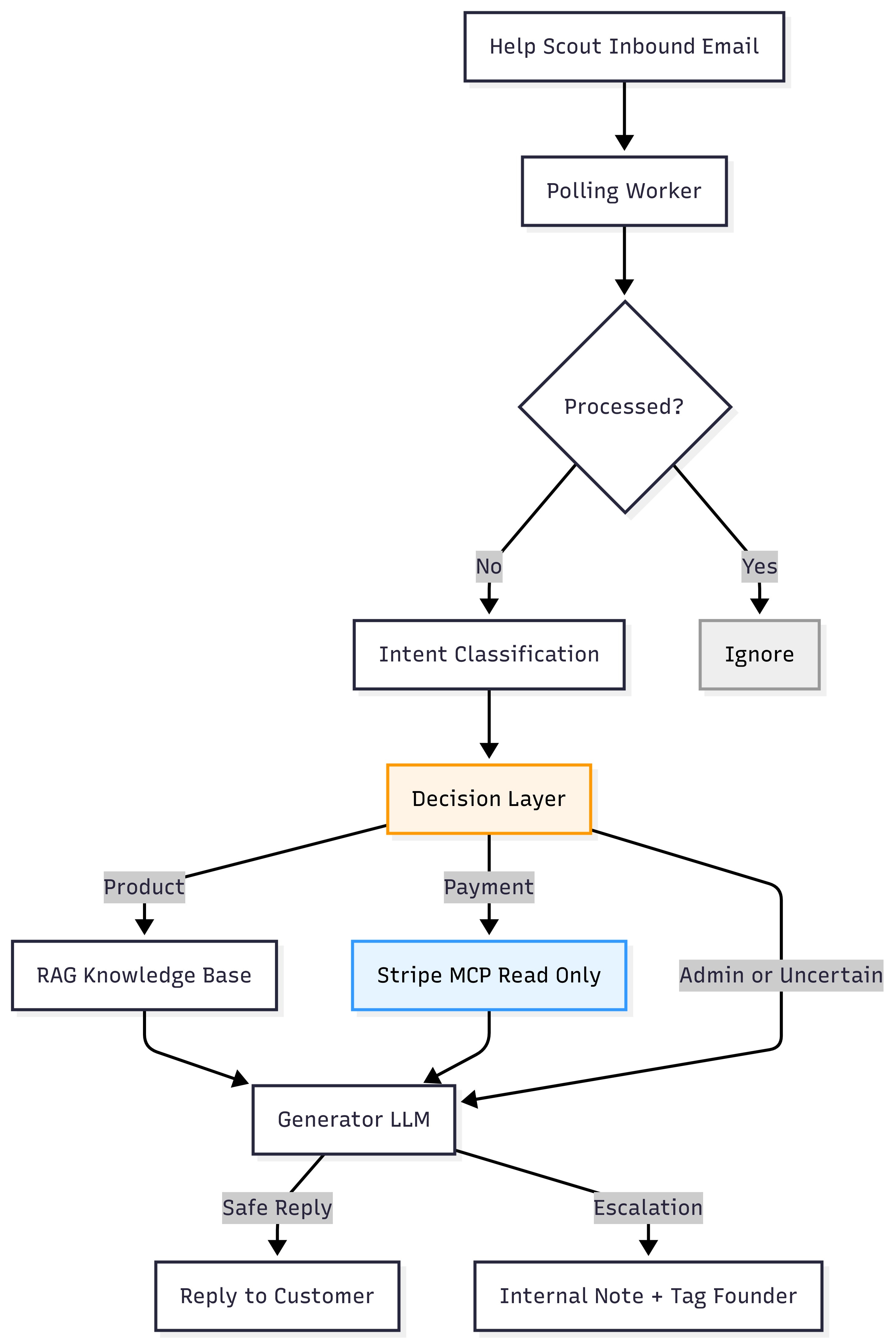
The system follows a linear, safety-first pipeline:
- Poll inbound customer messages from Help Scout
- Classify intent (product / payment / admin)
- Decide whether to respond or escalate
- Perform deterministic tool calls if required
- Generate a response or an internal note
- Post results back to Help Scout
Architecture
The system operates under strict constraints:
- Help Scout Integration: Polls inbound customer messages
- Intent Classification: Categorizes emails as product, payment, or admin requests
- Stripe MCP: Read-only access for payment inquiries, strictly tied to sender email
- RAG System: Retrieval-augmented generation for product knowledge
- Escalation System: Deterministic escalation with founder tagging for unsafe cases
Technical Breakdown
Key Technologies
- LLM Systems for intent classification and response generation
- Help Scout API for customer message polling
- Stripe MCP for read-only payment data access
- RAG for product knowledge retrieval
- Python for orchestration and safety logic
Challenges Solved
- Risk Management: Implemented aggressive escalation strategy to eliminate catastrophic failures
- Read-Only Constraints: Enforced strict read-only access to Stripe, preventing any data mutations
- Deterministic Escalation: Built system that escalates on uncertainty rather than guessing
- Idempotence: Implemented strict idempotence guarantees to prevent duplicate actions
- Guardrails: Prioritized safety over coverage, accepting over-escalation as acceptable failure mode
Guardrails & Safety Model
- No admin actions under any circumstance
- No Stripe write operations
- No responses outside documented knowledge
- Mandatory escalation on uncertainty
- Internal notes for all escalations with founder tagging
Results
- Production-adjacent system live and responding to real customer emails
- Safe autonomy without handholding, reducing support load
- Zero security incidents through strict guardrails and read-only constraints
- Deterministic escalation ensuring no incorrect or sensitive disclosures
- Internal context enrichment with Stripe data when appropriate
What I Learned
This project demonstrated the importance of risk-aware LLM design and disciplined constraint setting. Building safe autonomous systems requires prioritizing guardrails over coverage and accepting conservative escalation as a feature, not a bug. The key insight was that the hardest part of autonomous systems isn't making them work—it's knowing when not to let them work.
Next Steps
Planned improvements include:
- Webhook-based ingestion for lower latency
- Explicit handling of email mismatches
- Expanded edge-case simulation
- Higher-quality reasoning models
- Admin automation remains out of scope